
MS Ashmole 209
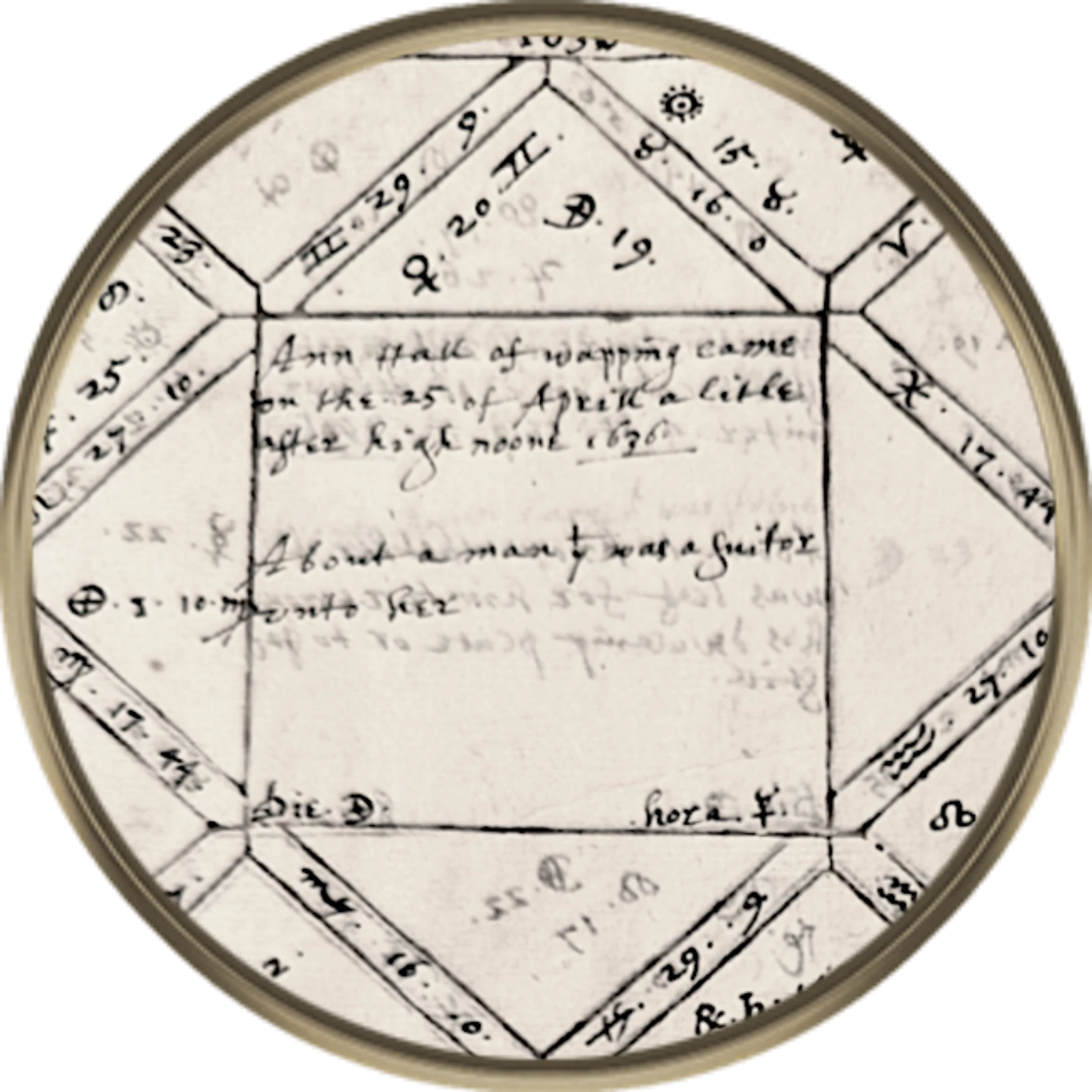
"Two hundred and seven Select Figures set on Horary Questions, with the astrological judgement given on each, and the actual event or consequence; by William Lilly. F. 1-104b. These are very neatly drawn (out of his practice-books and papers) and discoursed on: there is one figure with its judgement on each page (except 95b, which is blank), and ff. 105-30 contain only the frame of the figure stamped, but not filled up."
* note updated text below, clarifying these charts are the work of Jeffery Neve.
Because these horary charts were filed under Lilly’s name by the Bodleian Library, it was initially believed that these horoscopes were unpublished charts from Lilly’s own case notes. But they are not – they are the work of a contemporary London astrologer, Jeffery Neve (1579–1654). The Dictionary of National Biography entry on Neve tells us:
We are fortunate that works such as this were preserved by Lilly’s life-long friend, the politician Elias Ashmole (1617-1692), who shared his interest in astrology, alchemy, and natural philosophy. Ashmole’s wealth was matched by his enthusiasm for collecting artefacts, curiosities and manuscripts that touched on these subjects, and he gathered an incredible private collection of fascinating resources. This was gifted to the University of Oxford in 1677 on condition that a suitable home be built to make them available to the public. The Ashmolean Museum was completed in 1683 as the oldest public museum in the UK.
Custody of the manuscripts in the Ashmole collection was transferred in 1860 to the Bodleian Library, the central research archive of the University of Oxford and one of the oldest libraries in Europe. The main components of the collection known as the Ashmole Manuscripts are:
A more informed study on the provenance of the horoscopes belonging to Neve is currently in review process, to be published at the Astra Project shortly. More details of that will be added to this page when available.

Jeffery Neve’s trove of horaries
Go to text
MS Ashmole 209
"Two hundred and seven Select Figures set on Horary Questions, with the astrological judgement given on each, and the actual event or consequence; by William Lilly. F. 1-104b. These are very neatly drawn (out of his practice-books and papers) and discoursed on: there is one figure with its judgement on each page (except 95b, which is blank), and ff. 105-30 contain only the frame of the figure stamped, but not filled up."
* note updated text below, clarifying these charts are the work of Jeffery Neve.
Because these horary charts were filed under Lilly’s name by the Bodleian Library, it was initially believed that these horoscopes were unpublished charts from Lilly’s own case notes. But they are not – they are the work of a contemporary London astrologer, Jeffery Neve (1579–1654). The Dictionary of National Biography entry on Neve tells us:
William Lilly, who knew Neve well, describes him as ‘a very grave person, laborious and honest, of tall stature and comely feature’. ... Among the Ashmolean MSS. at Oxford (No. 418) is a large folio volume by Neve, entitled ‘Vindicta Astrologiae Judiciariae, or the Vindication of Judicial Astrologie … Approved, Confirmed, and Illustrated by 600 of Experimentall Observations’ … Lilly in his ‘Life’ (loc. cit.) says, that Neve, having offered the figures for his inspection, he corrected thirty out of forty of them; and that the book was then (1667) in the possession of Richard Saunders, the astrologer. It is also mentioned by John Gadbury in his ‘Collectio Geniturarum’ (p. 179). A Latin translation of it by Miles Beveridge is Ashmolean MS. 400. In the same collection (No. 379, 2 b) is an ‘Epistola seu αποσπασματιον quoddam,’ which is subscribed ‘Galfridus Le Neve.’
We are fortunate that works such as this were preserved by Lilly’s life-long friend, the politician Elias Ashmole (1617-1692), who shared his interest in astrology, alchemy, and natural philosophy. Ashmole’s wealth was matched by his enthusiasm for collecting artefacts, curiosities and manuscripts that touched on these subjects, and he gathered an incredible private collection of fascinating resources. This was gifted to the University of Oxford in 1677 on condition that a suitable home be built to make them available to the public. The Ashmolean Museum was completed in 1683 as the oldest public museum in the UK.
Custody of the manuscripts in the Ashmole collection was transferred in 1860 to the Bodleian Library, the central research archive of the University of Oxford and one of the oldest libraries in Europe. The main components of the collection known as the Ashmole Manuscripts are:
- 1. Papers of Dr Simon Forman (1552-1611)
- 2. Medical and astrological papers of Dr Richard Napier (1559-1634), Theodoricus Gravius and John Dee (1527-1608)
- 3. Collections - chiefly astrological - of John Booker (1603-1667) and William Lilly (1602-1681)
A more informed study on the provenance of the horoscopes belonging to Neve is currently in review process, to be published at the Astra Project shortly. More details of that will be added to this page when available.
DH